
Blog

Hidden Carrying Costs of DFW's Fastest-Growing Suburbs (PID, MUD & More)
The listing says $4,800 a month.
You're going to pay $5,900.
That's the gap most DFW relocation buyers don't see coming, and it's the most preventable financial surprise in this market. Here's exactly where the gap lives, why it's growing, and how to catch it before you sign.
My job is to protect you from surprises. This is one of the biggest.
• • •
Why the Listing Number Lies
The listing isn't lying on purpose. It's just incomplete.
A standard DFW listing payment estimate usually shows:
Principal and interest
Estimated property taxes (often using last year's number)
Estimated insurance
Estimated HOA
What it usually doesn't show, or buries in fine print:
PID (Public Improvement District) assessments
MUD (Municipal Utility District) bonds
Tax rate escalations as the city/ISD catches up to growth
Community-specific dues or amenity fees beyond HOA
Insurance reality vs. insurance estimate (especially with wind/hail)
Builder-incentive financing that resets after year 2
Stack those, and a listing showing $4,800 is comfortably $1,000–$1,200 light per month in a lot of newer DFW communities.
You'll feel that gap on month two.
• • •
PID Districts: The Quiet Cost That's Everywhere Now
Public Improvement Districts are how a lot of new DFW master-planned communities fund their infrastructure — roads, parks, amenities, entry monuments, common areas.
Here's the part nobody volunteers at the model home:
PID assessments are not the same as property taxes
They typically run for 20–40 years
They can add hundreds of dollars a month to your real cost
They sometimes don't appear on the standard tax bill estimate
I've seen relocation buyers walk into a closing and see a PID line they didn't fully understand. By that point, you're not negotiating, you're just absorbing.
The fix is simple: every DFW new-construction community should be checked for PID before you make an offer. Not after. Not at title. Before.
• • •
MUD Districts: The Other Half of the Stack
Municipal Utility Districts are a different animal — they fund water, sewer, drainage infrastructure for areas that aren't yet part of a city's full utility map.
MUD bonds are paid off over time through a dedicated tax, on top of your normal property tax.
Some DFW communities have a PID. Some have a MUD. Some have both. The combined effect on your monthly cost can be material — and again, it's something a listing payment estimate is unlikely to fully reflect.
Before you fall for a house, find out:
Is this property in a MUD?
What's the current MUD rate?
How long is the bond expected to run?
Has there been any recent MUD rate revision?
A 30 minute phone call before the offer prevents a 30 year regret after the close.
• • •
Tax Rate Escalation: The Lag Most Buyers Miss
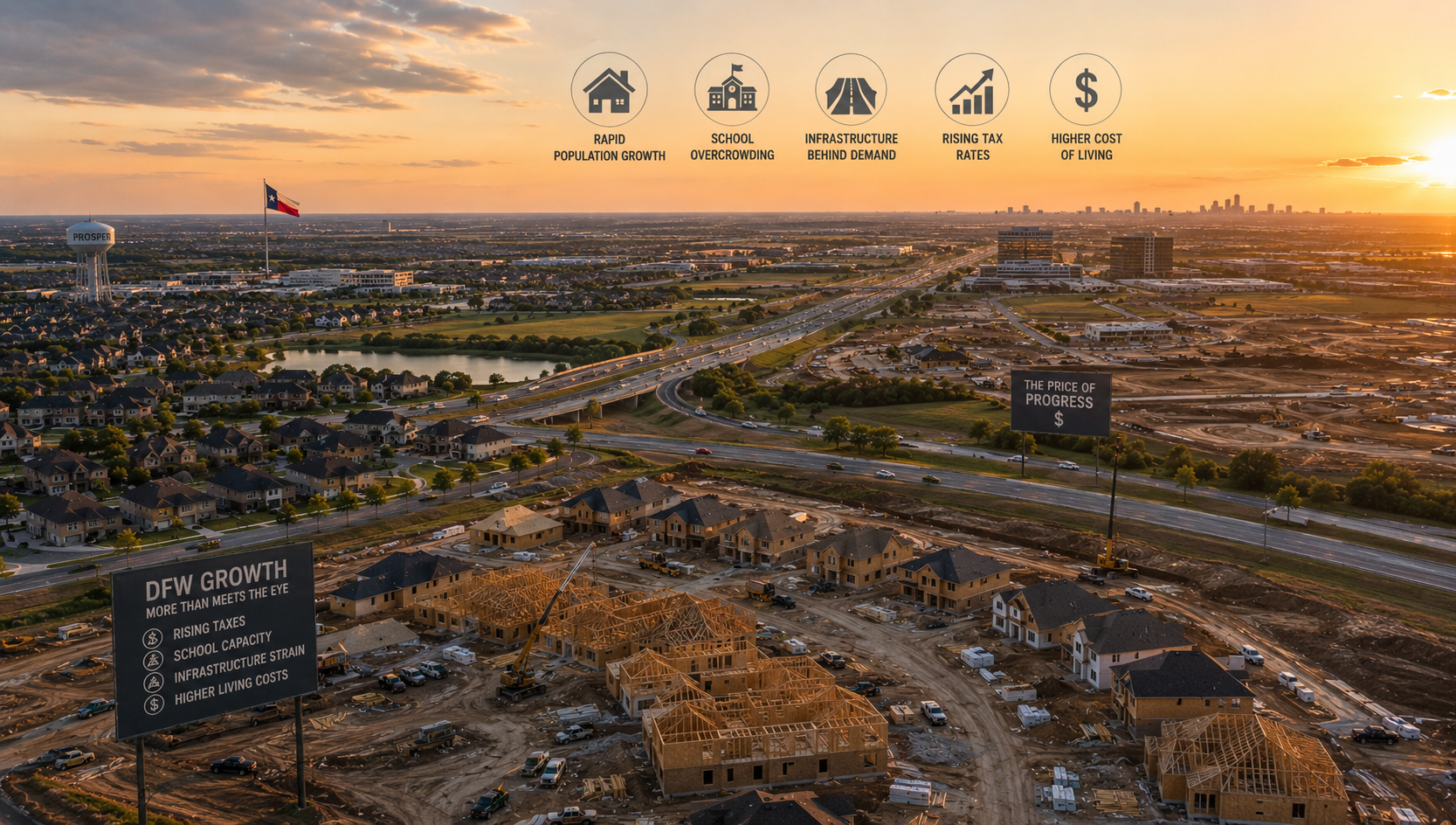
Here's something a lot of relocation buyers don't realize: the tax rate you see today in a fast-growing DFW community isn't necessarily the tax rate you'll be paying in three years.
When a city is in early growth phase, services lag behind rooftops. Eventually, the school district has to build more campuses. The city has to add fire stations, police, infrastructure. That gets funded — usually through bond elections that voters in fast-growing communities tend to approve.
This is normal. This is also expensive.
If you're moving into an early-growth community, you should expect the effective tax burden to drift up over the next several years. That's not a flaw in the community — it's a feature of growth. But you should price it in upfront, not be surprised by it later.
A good agent will model this for you. It's not hard math. It's just math nobody runs.
• • •
Insurance Reality vs. The Listing Estimate
DFW insurance is its own conversation.
Wind and hail claims have driven premium increases across the metro in recent years. Roof age, materials, and claim history matter more than they used to. The estimated insurance number on a listing is often based on a generic plug, not a real quote.
Before you commit, get a real quote. Not a ballpark. A real one, on the actual address, with the actual roof, with the actual claim history. That number is sometimes 20–40% higher than the listing estimate, especially on older homes or homes with recent claims.
This isn't a reason not to buy. It's a reason not to be surprised.
• • •
HOAs and Amenity Fees: The Layer Under the Layer
Most buyers know about HOAs. Fewer realize how layered they've gotten in newer DFW communities.
You might pay:
Master HOA dues (community-wide)
Sub-HOA dues (your section/neighborhood)
Amenity center fees (pools, fitness, clubhouses)
Front-yard maintenance dues (in some communities)
Special assessments (event-driven)
I've seen total HOA stacks run from $50 a month to $300+ a month depending on the community. Again — not bad, not predatory, just real. You need the full number before the offer, not after.
Ask for the most recent HOA budget, the most recent assessment history, and the planned reserve fund position. If anyone gives you push-back on those documents, that's information too.
• • •
Builder-Incentive Financing: The Year 2 Cliff
Here's the one I see catch the most relocation buyers in 2026.
Builders in DFW are using rate buy-downs heavily right now. 2-1 buy-downs, 3-2-1 buy-downs, permanent rate reductions in exchange for sticker price holds, lender credits, closing cost coverage — every flavor.
These can be genuinely good deals. They can also be cliffs.
If your buy-down resets in year 2 or year 3, your monthly payment changes. If you didn't qualify based on the post-buy-down payment, you're in a different financial reality at that point. If you didn't plan for it, you're scrambling.
Before you take a builder incentive, ask:
What is my payment in year 1, year 2, year 3, and year 4?
What would my rate be without this incentive?
Is this incentive contingent on using the builder's preferred lender?
What am I giving up to get this incentive?
Most relocation buyers can answer the first question. Almost none can answer the rest. That's where the surprise lives.
• • •
How to Run the Real Number Before You Make an Offer
Here's the workflow I walk every DFW relocation client through before any offer:
Pull the listing's stated estimate.
Verify the actual current property tax rate at the county appraisal level.
Check for PID — call the district directly if needed.
Check for MUD — same process.
Get a real insurance quote on the actual address.
Pull the current HOA package (budget, assessments, reserves).
If a builder incentive is involved, model years 1 through 5.
Add it all up. That's your real number.
Compare your real number to your real budget.
Decide.
This is a 90-minute exercise, total. It costs you nothing. It saves you from 30 years of "I wish I'd known."
• • •
The Suburb Where the Gap Hurts Most
The gap between listing estimate and real carrying cost is biggest in early-growth suburbs with heavy PID/MUD usage. That's not a knock on those communities — it's just where the math gets layered.
Mature suburbs like central Frisco, established Plano, parts of Allen and McKinney tend to have smaller gaps. The taxes are settled. The PIDs are usually paid down. The HOA structures are mature. What you see is much closer to what you pay.
Newer corridors — parts of Celina, parts of Prosper, newer Aubrey, newer Northlake — tend to have wider gaps. Not because they're worse. Because the funding model is different.
Knowing which kind of suburb you're in changes how aggressively you have to dig.
• • •
The Pointman Promise: No Surprises at the Table
Every relocation client I work with gets the full carrying-cost picture before we write an offer. Not at the closing table. Not at the inspection. Before the offer.
That's the difference between buying a house and buying a financial decision you can actually live with.
If you're shopping in DFW right now and you're not sure your numbers are real, let's run them. Mission-first. First through the door. Clears uncertainty.
That's the job.

Get In Touch With Us





Locate Us
Location:
1024 E Broad St #101, Mansfield, TX 76063
Tel: (214) 949-2040
Email: [email protected]