
Blog

Buying a House in DFW With a VA Loan | Louis Pacheco
Buying a house in DFW with a VA loan requires structure. It is not just about getting a pre-approval letter and looking at listings. It is about aligning federal appraisal guidelines with Texas environmental realities.
Successfully executing a VA loan requires buyers to pass strict federal Minimum Property Requirements (MPRs) in a region known for foundation movement. They should also actively leverage Texas property tax exemptions to drastically lower their monthly carrying costs. Veterans who understand this intersection hold a massive tactical advantage in the housing market.
How Do DFW Foundation Realities Impact the Home Buying Process?
A VA loan is a federally backed benefit. The Department of Veterans Affairs guarantees a portion of the loan, and in return, they demand that the property is safe, structurally sound, and sanitary. They enforce this through Minimum Property Requirements (MPRs).
This is the risk most people miss: The DFW metroplex sits on highly expansive clay soil. This ground absorbs water and swells during spring rains, then shrinks and cracks during dry Texas summers. This constant movement takes a heavy toll on concrete slab foundations.
When you buy a house in North Texas, minor settling is common. But a VA appraiser is actively looking for signs of structural failure, like:
Exterior Brick Separation: Large stair-step cracks in the mortar.
Failing Roofs: Missing shingles or active leaks caused by recent North Texas hailstorms.
Window and Door Alignment: Doors that will not latch or windows that are painted shut due to the house shifting.
Exposed Wood and Peeling Paint: The VA strictly flags peeling paint on homes built before 1978 due to lead risks, but they also flag rotted wood on exterior fascia boards in newer homes.
If the appraiser flags these items, the home fails the MPR check. The seller must complete the repairs before the lender will clear the loan to close. In a competitive market, sellers often refuse.
You need an agent who pre-screens the property for these exact MPR red flags during the initial walkthrough.
How Do Texas Property Tax Exemptions for Disabled Veterans Work?
Texas does not have a state income tax. The state funds public infrastructure through high property taxes. While this is a heavy financial burden for standard buyers, it provides a great advantage for disabled veterans.
The State of Texas offers substantial property tax relief based on your VA service-connected disability rating. This directly impacts your monthly escrow payment and your overall purchasing power. You must file for this exemption with the local county appraisal district immediately after closing. It is not automatic.
Texas Veteran Property Tax Exemption Scale
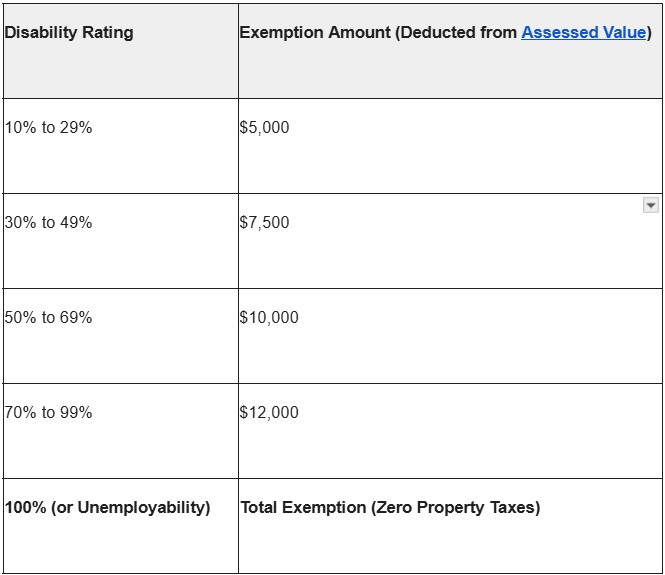
Note: Texas law also provides exemptions for surviving spouses. County guidelines dictate exact application deadlines.
If you hold a 100% service-connected disability rating, your property tax bill drops to zero. In Dallas-Fort Worth, where property taxes often exceed $800 to $1,200 a month on a standard home, this exemption allows you to buy a significantly better house while maintaining a conservative monthly budget.
Always provide your lender with your disability award letter upfront. The lender must exclude the estimated property taxes from your debt-to-income (DTI) ratio, giving you a clear, accurate picture of your buying power.

What Is the Execution Timeline for a DFW Veteran Buyer?
The Texas real estate contract moves fast, and out-of-state military families often feel rushed. Here’s a structured execution plan to eliminate the panic.
Phase 1: The Reconnaissance (Days 1–15)
Secure the COE: Obtain your Certificate of Eligibility (COE) from the VA portal. This proves your entitlement to the lender.
Full Underwriting: Do not settle for a basic pre-qualification. Force the lender to fully underwrite your file. This means they verify your income, debt, and credit before you even look at a house.
Target Mapping: Map out target neighborhoods based on your commute to the base or civilian job, avoiding the worst DFW toll road choke points.
Phase 2: The Ground Game (Days 16–30)
MPR Screening: Tour properties and actively look for foundation failure, roof damage, and safety hazards that will fail the VA appraisal.
Strategic Bidding: When you find the right asset, structure the offer better. It’s important to include a strong option fee and clear timelines. Your realtor can also call the listing agent and explain that your fully underwritten VA loan is safer than a shaky conventional offer.
Phase 3: The Option Period (Days 31–40)
Independent Inspection: The VA appraisal is not a home inspection. You must hire an independent Texas-licensed inspector.
Foundation Verification: If the inspector suspects structural issues, your realtor must immediately order a specialized structural engineer or foundation company to assess the slab.
Renegotiation: Use the option period to force the seller to address major safety defects or MPR violations.
Phase 4: Appraisal and Closing (Days 41–60)
The VA Appraisal: The lender orders the appraisal. The appraiser verifies value and MPR compliance.
Clear to Close: The underwriter issues the final approval. We conduct a final walkthrough of the property to ensure no new damage has occurred.
Execution: You sign the closing documents, and we hand over the keys.
Navigating New Construction With a VA Loan
Many veterans gravitate toward new construction in the Dallas-Fort Worth suburbs. A brand-new house easily passes the VA Minimum Property Requirements, bypassing the stress of repairing an older home.
But buying a new build requires extreme caution. The builder’s sales representative works for the builder. Their job is to protect the builder's profit margin.
The Builder Lender Trap: Builders heavily incentivize buyers to use their in-house lender by offering thousands of dollars in closing cost credits. You must aggressively compare their loan estimate against an independent VA lender. Often, the builder's lender inflates the interest rate or adds hidden origination fees, effectively making you pay for your own "incentive."
Independent Representation: Never sign a builder's contract without an independent real estate agent reviewing the timeline and the terms. We ensure your earnest money is protected and that the builder allows third-party phase inspections during the construction process.
Why Do Sellers Fear VA Offers, and How To Fix It?
Listing agents and sellers often misunderstand the Texas VA loan process. They assume the VA appraiser will deliberately undervalue the home or demand unreasonable repairs. This ignorance leads to rejected offers.
I, Louis Pacheco, help fix this through direct communication and tactical preparation.
Defeating the Low Appraisal Myth
Sellers fear that a VA appraisal will come in low and kill the deal. They do not understand the Tidewater Initiative. If a VA appraiser believes the home is not worth the contract price, they cannot just blindly issue a low report. They must invoke Tidewater.
Tidewater pauses the appraisal and gives the real estate agents 48 hours to provide recent, comparable sales data to justify the price.
This is a massive tactical advantage. It gives us a window to defend your contract. If the appraiser still refuses to meet the price, you are protected. The VA escape clause guarantees you get your earnest money back if the home does not appraise. It prevents you from buying a bad asset.
Educating the Listing Agent
When I submit your offer, I do not just email a PDF. I call the listing agent and explain that your file is fully underwritten. I also go into detail on how the house is pre-screened for MPRs, meaning there will be no surprise repair demands later.
How Can I Help Execute Your VA Loan
You will never feel lost, rushed, or uninformed. I treat your home purchase as a mission. I do not deal in hype. I deal in clear, actionable intelligence.
If you are buying a house in DFW with a VA loan, my job is to protect you from surprises. I personally evaluate the structural integrity of the home. I verify your tax exemptions. I aggressively communicate with the seller's agent to ensure your offer is respected and understood.
I bring calm authority to a stressful process. You served to protect others; my mission is to protect your family’s financial future.
Frequently Asked Questions
Is a VA appraisal the same as a home inspection?
No. A VA appraisal determines the fair market value of the property and ensures it meets basic Minimum Property Requirements (MPRs) for safety and sanitation. A home inspection is a deep, exhaustive evaluation of all the home's systems, from the HVAC to the foundation. You must always hire an independent home inspector.
Can I buy a multi-family home in DFW with a VA loan?
Yes. You can use your VA loan benefit to purchase a multi-family property with up to four units, provided you intend to live in one of the units as your primary residence. This is a highly effective strategy for building long-term wealth.
What happens if a house fails the VA appraisal in Texas?
If a home fails the MPR portion of the appraisal, the seller must agree to complete the required repairs before closing. If the home appraises for less than the purchase price, you can renegotiate with the seller, pay the difference in cash, or walk away and receive your earnest money back using the VA escape clause.
Do disabled veterans pay property taxes in Texas?
It depends on your service-connected disability rating. Texas offers a sliding scale of property tax exemptions for disabled veterans. If you have a 100% disability rating or are classified as unemployable, you are completely exempt from paying property taxes on your primary residence.
If you are ready to execute a structured, risk-aware home search in North Texas, I can help you as your Pointman. Reach out to me to establish your execution plan and secure your objective.

Get In Touch With Us





Quick Links
Locate Us
Location:
1024 E Broad St #101, Mansfield, TX 76063
Tel: (214) 949-2040
Email: [email protected]